How one man’s observation in 1983 gave the world a new language for keeping people safe.
This page documents the earliest use of the term “safety culture” and how the idea evolved to change the way that workplace safety was practiced and managed.
Dr. Steve Simon addressing the National Safety Congress, Chicago — October 7, 1987
Chronology
Before Safety Culture Had a Name
The plant manager at the WIDCO coal mine in Centralia, Washington had a question for Mary O’Donnell, his supplier of safety awards.
Did she know a “motivational psychologist”? A motivational psychologist at a coal mine?
The manager faced a problem he couldn’t solve with the tools available to him. His incentive awards weren’t working. He needed something deeper — a way to get miners to speak up, take ownership, and look out for one another.
Mary knew someone who might be able to help. She picked up the phone and called Dr. Steve Simon.
That call would change the history of workplace safety.
The Father of Safety Culture
Dr. Steve Simon is a Harvard-trained motivational psychologist whose thinking was shaped years earlier at Brandeis University under Abraham Maslow — the renowned psychologist behind the “Hierarchy of Needs.”
Maslow steered him away from clinical treatment of individual patients and toward the study of communities and groups capable of lasting behavioral change.
Abraham Maslow, whose mentorship redirected Dr. Simon toward the study of group culture and behavior change.
Following that path, Dr. Simon spent years working inside a therapeutic recovery community — a structured residential setting for people overcoming addiction. Despite relapses, arguments, volatile behavior, and even threats of violence, the community had almost zero safety incidents.
Why?Not because of safety rules. Not because of engineering controls. Not because of safety incentives.It was the culture of the group — the shared norms, values, and expectations — that kept people safe.
Spring 1983
The Aha! Moment
A few months before Mary O’Donnell called him about a coal mine, a friend recommended a new book Corporate Cultures: The Rites and Rituals of Corporate Life by Deal & Kennedy.
Reading it, Dr. Simon experienced what he later called his “Aha moment.” He connected the dots.
If culture could shape behavior so powerfully in a therapeutic community, perhaps those same principles could be deliberately engineered into the industrial workplace.
He gave the idea a name:Safety Culture.
It was the first time anyone had ever put those two words together with intention.
The book that triggered the Aha! moment
Summer / Fall 1983
The First Safety Culture Implementation in History
In August 1983, Dr. Simon and Mary submitted a proposal to the WIDCO mine. It was accepted.
In October 1983, he wrote a set of speaker notes for management to introduce the program. Goal Number 5 stated the purpose plainly:
Primary sourceOctober 28, 1983
Written in bold capital letters, this document — Notes for Presentation of the WIDCO Safety Incentive Program, dated October 28, 1983 — contains the earliest known use of the term SAFETY CULTURE in print.
“Establishing a SAFETY CULTURE.”
In November 1983, Dr. Simon flew to Centralia to launch the first safety culture workshops ever conducted. The WIDCO project became the first corporate Safety Culture implementation in history.
What began as an innovative idea was now a real-world experiment.
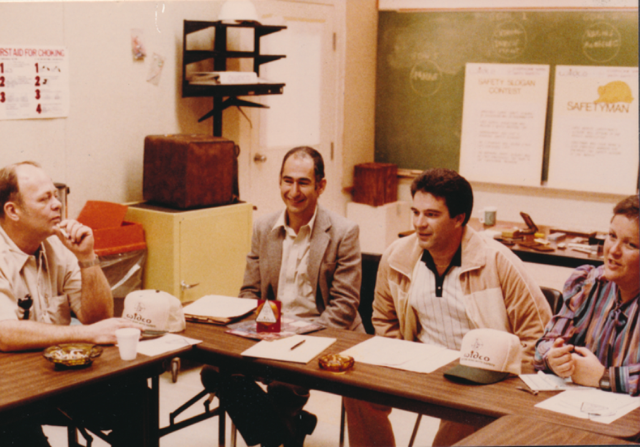
Right to left: Mary O’Donnell, Doug Johnson (Safety Manager) and Dr. Steve Simon. WIDCO Mine, November 1983. From the original WIDCO project scrapbook.
Main building, WIDCO Mine, Centralia, Washington
Equipment and mine in operation — November 1983
1984 – 1987
Testing the Idea
WIDCO was the beginning, not the proof. The real test was whether Safety Culture could work across industries, workforces, and organizational cultures.
It did.
~50%
Watsonville Canning
A 1000-employee food processing operation: injuries dropped by nearly 50% within twelve months.
↓
Continental Airlines
Property damage dropped dramatically.
GE
GE Greenville
Cultural change produced measurable improvements in safety performance.
The framework wasn’t theoretical. It was producing results.
1984 – 1986
Taking It Public
At the same time, Dr. Simon began bringing the concept to professional audiences.
1984He presented at a safety conference in Houston, TX for the oil and gas industry.
1985 – 1986Between Spring 1985 and Spring 1986, he presented at the Western Safety Congress in Anaheim, CA.
Late 1986The term appeared in a report on the Chernobyl accident.
He often faced skepticism: “Why do the words safety and culture belong in the same sentence?”
But others were excited by the new direction. Attendees began to apply the Safety Culture ideas that they heard in their own workplace.
1987
In His Own Words at the National Safety Congress
By 1987, the concept was ready for a national stage. Interest in safety culture was spreading. The conference rooms at Dr. Simon’s talk were filled.
National Safety Congress – Chicago, October 7, 1987. Dr. Simon delivered what is believed to be the earliest video-recorded presentation on Safety Culture. In that address, he made the case for why safety culture is a more powerful motivator than rules or incentives:
I’m going to propose that one of the keys to motivation is the establishment of a strong Safety Culture. That cultures themselves are the best motivators. What you absorb through the pores of your skin in a culture dwarfs the power of the other two to motivate.
— National Safety Congress, Chicago — October 7, 1987
Seven core ingredients organizations can intentionally develop
Communicating safety values
Promoting storytelling
Introducing safety rituals
Propagating safety language
Creating safety heroes
Enlisting top management
Displaying safety artifacts
1988
The Architecture of Safety Culture Change is in Full Focus
By the time Dr. Simon took the stage at the American Society of Safety Engineers (ASSE) Exposition in Las Vegas in 1988, he had spent five years implementing, testing, and further refining the concept of safety culture in US workplaces.
In this talk, he speaks about how to establish a safety culture within an organization, about what the components of a safety culture are, about a tool to analyze safety cultures and design programs to build them, and on case histories of companies that developed strong safety cultures.
Principles now considered foundational to the field
ISafety culture is a journey; it is not a destination.
IISafety culture begins with a clear statement of values.
IIIThe best prevention for accidents is the culture itself.
In his closing message, he challenged the profession directly
“I would feel successful today if you consider buying into a philosophy that safety is a cultural process that is never ending, and that part of the permanent answer to accidents is the continual work on the cultural process… The ball is in your court. There are no magic answers, but we can roll up our sleeves and work not only on the conditions, but on the cultures of our companies.”
ASSE Exposition, Las Vegas — 1988
Safety Culture was no longer an idea. It was a discipline.
Three clips from the ASSE Exposition
Establishing a Safety Culture Dr. Simon talks about the power of safety culture to protect people every day.
7 Elements of Safety Culture Dr. Simon outlines seven key ingredients for building and sustaining a positive safety culture.
Working on Culture Caption to be supplied.
Today
From Innovative Idea to Global Standard
In the early years, many asked why “safety” and “culture” belonged in the same sentence. Today, that question has disappeared.
Safety Culture is spoken in boardrooms, regulatory frameworks, and corporate offices worldwide. Tens of thousands of organizations use it. Thousands of practitioners build careers around it.
But it began in a specific way — with a mine that needed help, a psychologist with an unconventional insight, and a moment of clarity that changed how the world thinks about keeping people safe.
“Safety culture was an observed reality, given a name, and tested in organizations willing to pursue significant change.”
— Dr. Steven I. Simon, Ph.D.
The Record
Documented through preserved primary sources
ProposalOriginal August 1983 WIDCO proposal and October 1983 speaker’s notes
VideoOriginal video recordings of the 1987 National Safety Congress and 1988 ASSE presentations
NotesContemporaneous conference notes from the 1984 Houston Safety Symposium
AffidavitsSworn affidavits from attendees of Dr. Simon’s early talks
These materials form the documentary foundation of the field.
Continuing the Movement
Dr. Simon and his team have been shaping the global safety landscape since the beginning — from the first implementation in 1983 to today’s enterprise-wide cultural transformations.
Whether you are an organization seeking a stronger safety culture, a researcher verifying the origin of the movement, or a safety professional looking to deepen your practice, you are connecting with the source — Culture Change Consultants, Inc.